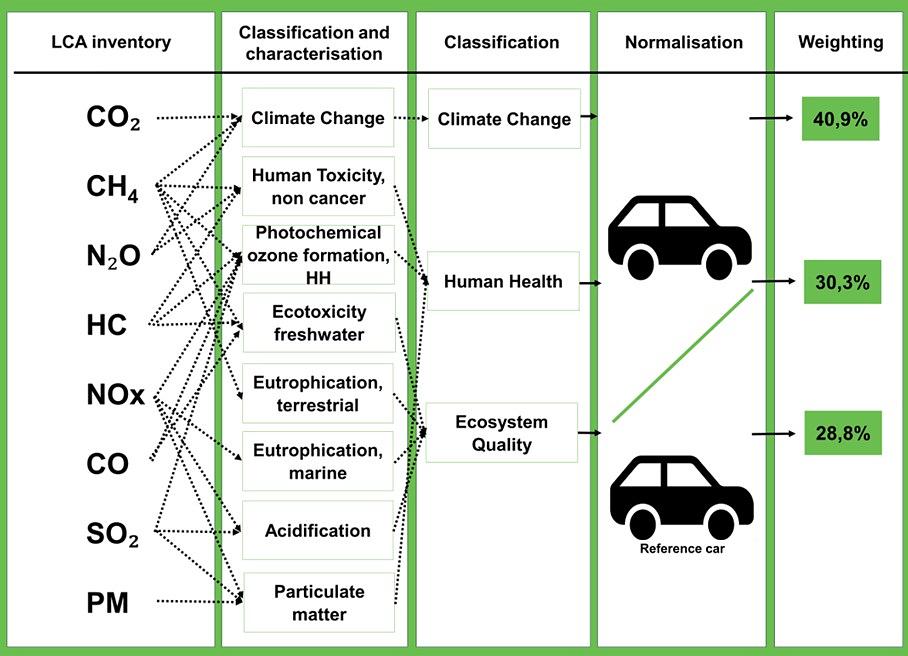
The methodology used to calculate the Life Cycle Impact follows the steps based on life cycle assessment: inventory, classification, characterisation, normalisation, and weighting. It includes exhaust emissions (direct emissions) and emissions from production to the end-of-life (indirect emissions). All emissions are classified into the impact categories from the Environmental Footprint 3.1 (EF3.1) methodology from the European Commission, and then classified into three damages: climate change, human health, and ecosystem quality. The figure below gives an overview of the methodology.
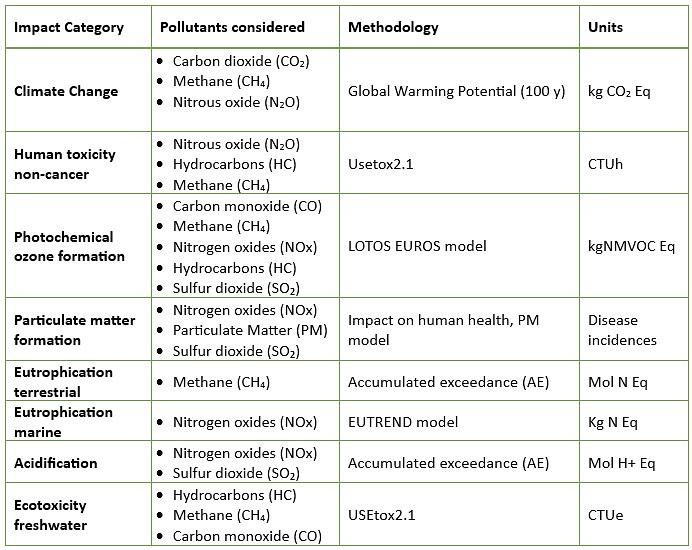
The specificity of the inventory of Life Cycle Impactis that only the pollutants used in the Ecoscore methodology and their impacts on the corresponding impact categories of EF3.1 are considered. The characterization factors are taken from the EF3.1 database. Noise is not included in the EF3.1 methodology and, therefore, is not considered in the Life Cycle Impact.
Classification and characterization
Different impact factors are used to characterize the contribution of each pollutant to the damage category they belong to.
For each impact category, each pollutant emission is multiplied by the corresponding characterization factor of the corresponding methodology provided by EF3.1. For the indirect emissions, the emission factor is used to quantify the overall pollutant emissions as in the equation below:
with:
Ei,indirect = the total equivalent emissions for the impact category i in the units of the impact category per km
EFx,j = the emission factor of the pollutant j for the indirect impact of the life cycle phase x (i.e., impact from fuel production)
Cfi,j = the characterization factor of the pollutant j for the impact category i
FC = fuel consumption of the vehicle
Bcap = battery capacity of the vehicle
m = mass of the vehicle (without battery for EV and hybrid)
d = total lifetime distance set to 200,000 km
Normalization
The total impacts are normalized for each damage category and vehicle, given the damage associated with a reference vehicle. It is defined as an electric vehicle with a mass of 976kg, a battery of 26.8kWh and a consumption of 13.8kWh/100km (based on the 2023 Dacia Spring). For each impact category i, the total emissions (direct and indirect) are divided by the one for the reference vehicle as follows:
With Qi = total emissions of category i
With
qi = normalized emissions to the reference vehicle
Qref = total emissions for the reference vehicle
Weighing
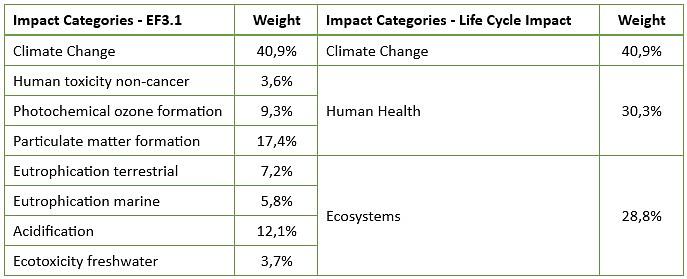
The weighing of the 8 impact categories that were withheld are adapted from the weighting of EF3.1. Three impact categories into one indicator are based on the weights that you find in the following table.
For communication purposes and consistency with the Ecoscore method, the impact categories are sorted into 3 main impact categories: Climate Change, Human Health and Ecosystems. Summarizing the weights of the different impact categories into each 'main' impact category results in the following: 40,9% for climate change, 30,3% human health, and 28,8% ecosystems.
The total impact is calculated as follows:
With:
TI = Total impact
αi = weight of the impact category i
lifecycleimpact.be maakt gebruik van noodzakelijke cookies. Om je gebruikerservaring op onze website te optimaliseren willen we ook gebruik maken van optionele cookies waarvoor we je toestemming vragen.